
 Sample — Not Yet For Sale
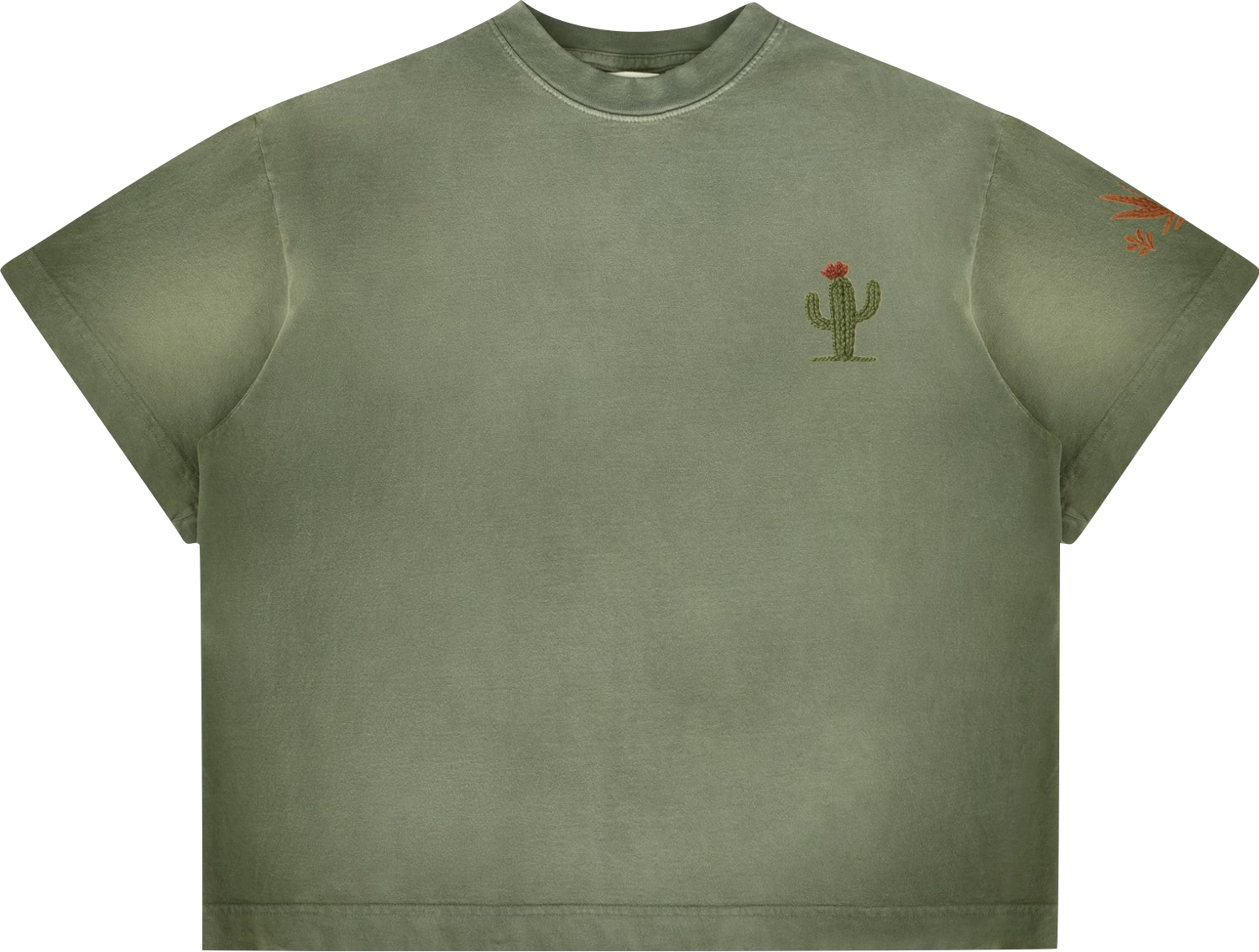
Sonoran Sage Bloom Tee
Sage Green · 180gsm · Chain-Stitch Embroidery · Vintage Single-Stitch
The dusty, muted green of saguaros, palo verde, creosote — the living color of a living desert.
- Chain-stitched cactus bloom over the heart
- Substantial 180gsm heavyweight drape
- Vintage single-stitch construction
- Sagebrush Fade wash — gentle weathering
- Modern silhouette, archival feel
This garment exists today as a production sample — real fabric, real construction, not yet for sale. We'll open the list when it's ready.
Get Notified
Sonoran Sage Bloom Tee
There are deserts that test you, and there are deserts that teach you. The Sonoran Desert does both. It’s the only desert in North America that feels alive in a way that borders can’t contain — stretching from Arizona into Sonora, Mexico, slipping down into Baja, brushing up the edges of California, and spreading quietly into New Mexico. It’s a single ecosystem cut into pieces on a map, but unified in every real way that matters: by the bloom, by the heat, by the color that defines it.
That color is sage — the dusty, muted green that coats saguaros, brittlebush, mesquite, palo verde, cholla, and creosote. It’s not the lush green of forests or the neon green of youth. It’s the green of survival. The green of patience. The green of plants that drink with caution and live with intention. This tee carries that shade — not a fashion green, not a trend green, but the living green of the borderland itself.
And then there’s the bloom. For most of the year, the Sonoran looks restrained, almost minimal in its palette. But when conditions align — when the rains come at the right time, when the temperature rises just so — the desert detonates into color. Saguaro crowns burst white. Ocotillo ignite orange. Prickly pear erupt in magenta and saffron. It lasts days, maybe weeks. Blink and you miss it. But if you catch it, you never forget it.
The chain-stitched cactus bloom embroidered over the heart is for that moment — the quiet miracle that reminds you that even harsh landscapes have softness built in. The raised threads echo the textures of desert plants: ribbed, spined, tender at the tip of each petal. Embroidery was chosen deliberately — it is more permanent than ink, more dimensional than print, more faithful to the feel of the bloom itself.
But you can’t talk about the Sonoran without talking about the people who shaped it. Long before Arizona existed, before Mexico gained independence, before Spain arrived in the 1500s, the Tohono O’odham lived in this land as if in dialogue with it. They grew crops in desert floodplains, harvested saguaro fruit using long wooden poles, followed seasonal water, and saw the desert not as a void but as a home. Their word for themselves translates to “desert people.” There is no more accurate name.
The Yaqui traveled these same valleys. Spanish missionaries built outposts along them. Mexican ranchers raised cattle in the shade of ironwood and mesquite. When the border moved after the Gadsden Purchase, the desert remained the same — ignoring politics, ignoring ownership, ignoring nationhood. A saguaro does not know if it is growing in Mexico or the United States. It only knows where the sun rises.
This tee belongs to that larger truth: that the West is not divided. It is connected by its land.
Made from 100% cotton in a substantial 180gsm, this shirt has weight — not heavy, but intentional. The kind of drape you find in old heavyweight blanks that have softened over decades. The single-stitch construction follows those archival patterns, giving the tee that subtle vintage roll at the sleeve hem and that unmistakable "old favorite" feel from day one. The Sagebrush Fade wash adds a gentle weathering, like sun on desert stone or wind on saguaro skin.
Wear it in Tucson. Wear it on the way to Nogales. Wear it on dusty roads through Hermosillo, or among the saguaros of Saguaro National Park. Wear it in Anza-Borrego when the ocotillo bloom. Wear it when the desert reminds you that life finds a way in the most unlikely places.
This is not a cactus tee. It is not a souvenir of the Sonoran. It is a living color from a living desert — stitched, softened, and shaped for the miles between places.